I had resolved to leave the Alaska of my birth, walking into a mist
of all the possibilities to be expressed in painting and through the
mind's lens of painting and the hands and mind of the painter and the
terrible infinity of the canvas. I was not good, until I was better; I
had to become better. And I saw this possibility in a painting from
life of a woman whose gentle power was so compelling that I wiped out
and repainted her image 60 or 70 times before the futility of it pushed
me to toss it in the dumpster.
Long gone, left in anguish on
that pile of garbage was the three by four foot illustration of her
luminous skin, her violet top, a wry smile, her maddeningly perfect
nose, all of this sunk among hundreds of distracting bad guesses of
proportion, color and light; that is the painting where I learned to
paint. I remember her sitting on that ugly beige sofa- a couple of hours
here and there. I remember my awe of her growing as I worked - my real
introduction to painting's ever-heightening of your awareness of the
whole perceivable world. I remember the futility of infusing the bright
colored mud with life, some echo of her being, resonant in living power
before me, and in memory; but was compelled to do so, to not just
passively see but to feel all of the resonances of that moment. I was
trying to illustrate, to empathize, to celebrate and impress at all
once. The painting was doomed.
One drive for making art is
hardly mysterious. She was beautiful inside and out. Her eyes flicked
with limitless curiosity, and her internal life unspoken flashed across
her countenance like a puff on the ripples of a ocean cove. And when she
spoke it was with quick wit, music and almost inexcusable wisdom.
Years earlier I might have tried a wheelie on a green Schwinn- I assure
you I would have crashed into the nearest ditch. But the motive force
is one thing; it's cheap, small-faced and unspeakably dull to reduce
human life to motive force. I fell for her of course. But bread is a lot
more than grain, water, salt and hunger.
It is interesting that
I cannot remember exactly where I painted it. 25 years have passed.
Maybe the studio downtown. I went through 4 studios in Anchorage that
year as landlords pushed me out when bigger money came calling.
A
few days out from the road away, I found this song; passing by late one
evening, I was out, she left me a cassette with this song.
It
is, by all rights, as sappy as as an old white spruce in late spring.
But it hits. Even Tupac loved this song, so much that his girlfriend
played it as he lay dying so that it would be the last sound he ever
heard.
The Art World doesn't seem to talk about Van Gogh much,
as famous as he is. I think we need to talk about him a lot more. Not
the pop culture version, not the over-elevation and branding of his
personal story, not the ludicrous string of half-scientific
"explanations" for his artwork.
I am convinced that Van Gogh's
best work is a kinetic product of him at his most perceptive, most open
to the truth, most magnificently and terrifyingly sane.
I think
of Cypress Trees. Simple trees, but each mark is infused with a wholly
unguarded connectivity, to the earth, the light, the living air, his
hand and eyes, the paint, all that is. Van Gogh was religious. The
painting and the act of making it is indistinguishable from the most
active and unguarded faith; I am irreligious, but at my best moments, I
glance something like it; any artist could.
While painting, I've
touched tenuously this connectivity between a person and the whole of
the perceivable world that comes through and is expressed by the act of
painting. That happened in little flashes in my garbage painting and I
saw, I think, more than I could manage- certainly more than I had the
skill to put in the work then.
We need to talk about what is to
be a human being, and how we build and recognize that, and grow it, and
why this is ever denied to anyone. And why this simple song is so close
to a truth of art.
Long since, I am grateful for the gift of that cassette.
Wednesday, August 01, 2018
Sunday, June 24, 2018
On "Untitled" 2015

Untitled is one of those paintings where I started it setting up problems that I could not have known how to finish until I dove into in - and indeed, was not happy about displaying until a key, nearly final little market brought it together enough to feel it was worth showing. Like many of my large paintings, including Patricia, Population, and another large Untitled piece in my studio, it is a of jazz, begun with a melody guessed and something of a color structure, and weeks, months, and sometimes years of refinement; it's executed reactively, in the moment, like jazz, but its structures emerge and are refined over time, like a classical work.
I've grown to like this one- it's also in that group of abstracts where
I worked on the edge of losing it constantly (painters will know
exactly what I mean). There are some paintings that you "give up" on
early, but keep working on, ready to follow where it leads only after
you surrender all your assumptions about what it SHOULD be.

If you look at the detail photo, the relationship between the two final marks: the isolated, complex and bilaterally symmetrical blueish mark in the upper right, and the leaf like folded mark in the lower right, after a lot of refinement, made the whole work well enough to show. The energetic forms that I forced into illusionistic space elsewhere in the painting (DeWitt Cheng ties this to Abstract Illusionism) could be much looser, but these two demanded very specific forms that were organically "believable," meaning that look less like paint and more like a painting of something specific.
But what? Here's a way to look at this: paintings are often about what is heard and felt, not only what is seen: if it works as visual music, I'm doing ok.
"Untitled" is available for view at my studio by appointment. Sales information is on my website, www.JamieBollenbach.com.

If you look at the detail photo, the relationship between the two final marks: the isolated, complex and bilaterally symmetrical blueish mark in the upper right, and the leaf like folded mark in the lower right, after a lot of refinement, made the whole work well enough to show. The energetic forms that I forced into illusionistic space elsewhere in the painting (DeWitt Cheng ties this to Abstract Illusionism) could be much looser, but these two demanded very specific forms that were organically "believable," meaning that look less like paint and more like a painting of something specific.
But what? Here's a way to look at this: paintings are often about what is heard and felt, not only what is seen: if it works as visual music, I'm doing ok.
"Untitled" is available for view at my studio by appointment. Sales information is on my website, www.JamieBollenbach.com.
"Fabricators"
Buttressed by the mushier flavors of critical theory divorced from
its humanistic core, this view of art in this NYT article, an old, Post-Warhol concept of the conceptual as supreme, elevates what are basically fussy
collectors as artists while Artists become mere "fabricators," patronized as heroic. It that now our
meaning of what is supposedly contemporary?
This view of this NYT article about what Art is, is very common in museums and especially in the high end of the art market; I think it often reflects a worldview not only doggedly amoral but hostile to that very process of creating meaning from all of the senses and all of the materials to signify what matters, art-making that has been part of the human experience since the very emergence of our species.
The "contemporary" view - at least a century old at this point - marginalizes poetry, the human hand and eye, dismisses both individuality and community and empathy. It's hostile to the value of creativity itself, and utlimately, by methodically eliminating why actual Artists- artists by any historical standard- would have any worth, it demands compliant enthusiasm for the dominance of rich people as the final arbiters of the human experience.
Ironically, it is often justified by a wholly degenerated form of pseudo-Marxist critique whose main point seems to celebrate the commodification of absolutely everything, particularly all the processes by which capital A Art is created.
You can always tell this view by the tired trope of "well Reubens/ Rembrandt/ Your Momma had assistants," or the ceaseless war on painting as a bourgeoise activity- so "bourgeoise" that every human child has an instinct for it, and you can see yourself up with a painting kit for about $30.
Museums now fill so often with half-art, cold, impoverished, 2nd tier illustration created by uncredited artists. This mirrors some patrons' Social Darwinism, Art as spectacle, as the wholly branded self, broad, empty, interchangable: parts that might as well be made by robots and sold on Amazon.
The mission to dismiss Artists as art makers seems a hell of a lot like a bid to erase Art that varies from a nihilistic world view: an erasure of deeply humanistic ideas/artworks born of the building and deepening interplay of material, hand, eye, senses and mind.
At real musuems and galleries, I take comfort in watching museum-goers invariably linger far longer, and engaged far more deeply, in the rooms of artworks sweated over and loved and credited to the people who not only thought of them, but earned the fully flowered refinement of their idea by the work of their hands and minds and senses, their whole being, physical and mental and spiritual wrapped inside the creation of the work.
That is a human being, seeing and making, in balance with the world. Why any feeling human being, let alone entire Art Schools, work so hard to destroy this is despairing
This view of this NYT article about what Art is, is very common in museums and especially in the high end of the art market; I think it often reflects a worldview not only doggedly amoral but hostile to that very process of creating meaning from all of the senses and all of the materials to signify what matters, art-making that has been part of the human experience since the very emergence of our species.
The "contemporary" view - at least a century old at this point - marginalizes poetry, the human hand and eye, dismisses both individuality and community and empathy. It's hostile to the value of creativity itself, and utlimately, by methodically eliminating why actual Artists- artists by any historical standard- would have any worth, it demands compliant enthusiasm for the dominance of rich people as the final arbiters of the human experience.
Ironically, it is often justified by a wholly degenerated form of pseudo-Marxist critique whose main point seems to celebrate the commodification of absolutely everything, particularly all the processes by which capital A Art is created.
You can always tell this view by the tired trope of "well Reubens/ Rembrandt/ Your Momma had assistants," or the ceaseless war on painting as a bourgeoise activity- so "bourgeoise" that every human child has an instinct for it, and you can see yourself up with a painting kit for about $30.
Museums now fill so often with half-art, cold, impoverished, 2nd tier illustration created by uncredited artists. This mirrors some patrons' Social Darwinism, Art as spectacle, as the wholly branded self, broad, empty, interchangable: parts that might as well be made by robots and sold on Amazon.
The mission to dismiss Artists as art makers seems a hell of a lot like a bid to erase Art that varies from a nihilistic world view: an erasure of deeply humanistic ideas/artworks born of the building and deepening interplay of material, hand, eye, senses and mind.
At real musuems and galleries, I take comfort in watching museum-goers invariably linger far longer, and engaged far more deeply, in the rooms of artworks sweated over and loved and credited to the people who not only thought of them, but earned the fully flowered refinement of their idea by the work of their hands and minds and senses, their whole being, physical and mental and spiritual wrapped inside the creation of the work.
That is a human being, seeing and making, in balance with the world. Why any feeling human being, let alone entire Art Schools, work so hard to destroy this is despairing
Monday, May 07, 2018
Three grumpy notes on the modern museum experience:
1. Far too many installation and video display shows take up gigantic amounts of gallery real estate far beyond their artistic merit. 1 artist (half the time skating on the craft of others) vs 50 who have might have displayed aesthetically worthy work. This habit shuts down, rather than enhances, the access of artists who are not experienced at playing the curatorial game- and those artists are so often well-connected, wealthy and all too often, facile.
2. Digital art is fine to the extent that it is emotionally and intellectually powerful: but digital art has uncounted outlets, as near as the screen you're reading this on. I love all kinds of museums, high, middle, and low, but the video- more video -MORE VIDEO has turned into a boring, repetitive, extremely didactic and emotionless experience, one easily supassed by curating for yourself at home on the screen you are using now. It should take up the precious resource of a museum gallery when A) it is truly outstanding, not merely visually loud, and B) aesthetically requires physical space to display, not merely insisting on the imprimatur of artiness that musuems convey.
3. If you show short narrative video, fine. Do it in wholly separate, theater were people can sit comfortably and it is not a horrible distraction from all other kinds of visual art nearby. Otherwise I assume your point is to shit on all other forms of art, which at points in history is fine, but don't pretend anything about this is transgressive. It's an old, old, old game now.
Open a movieplex, make a you-tube channel, sell an app, incentivize less lucky, more creative people make your work for you, install slightly unusual drywall arrangements, and make your t-shirts, like any normal capitalist operation. Fine. Just stop taking up so much space needed by any number of people who have something to show we'd all benefit from seeing.
Thursday, April 12, 2018
Fall in Love With the Damned World or We'll Never Save It
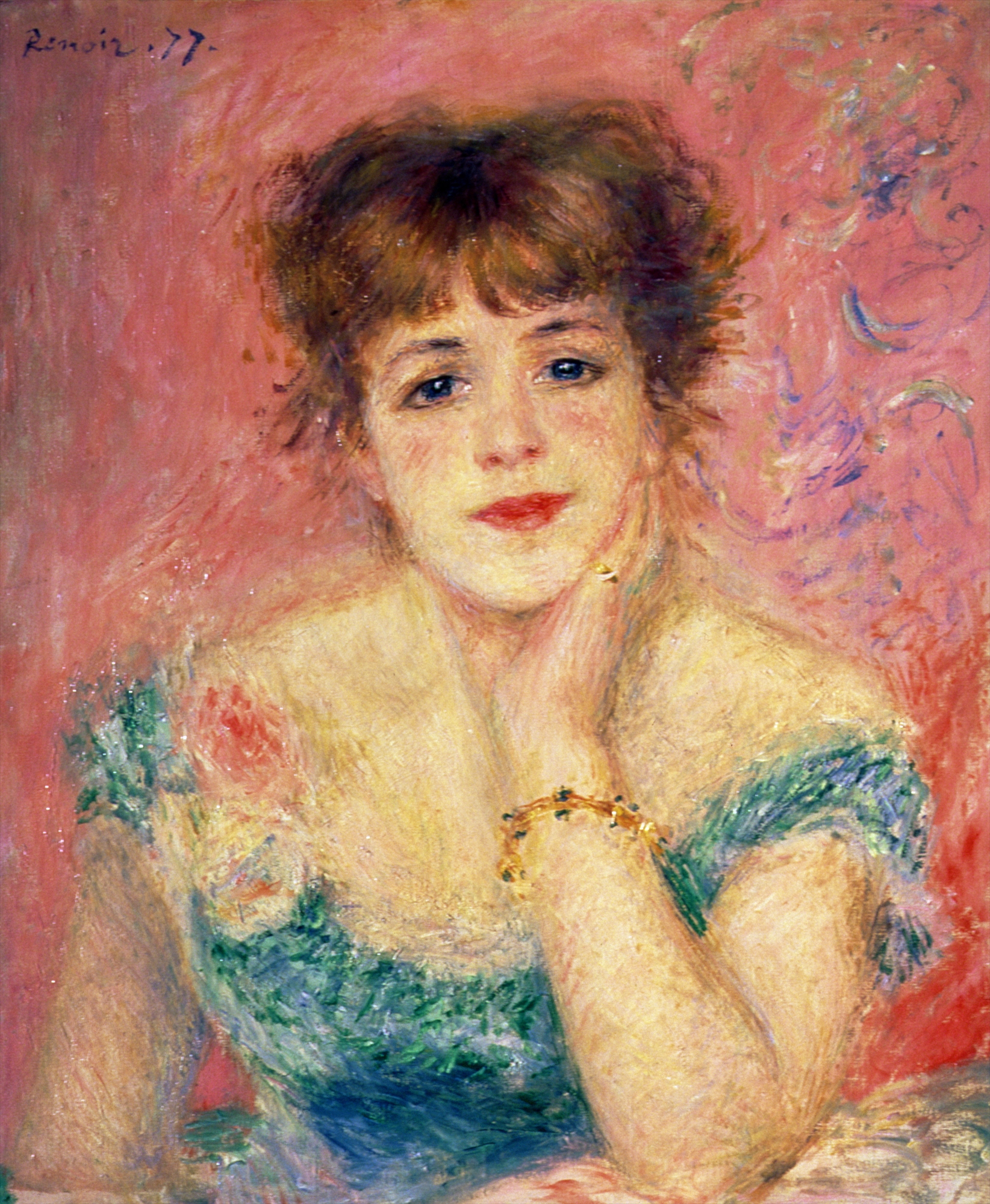
It's all wrong, a pink cream cheese flowery whip of a painting, a lovely woman painted in a lovely way with loving attention, in colors all too pretty in a room papered in pink swirls, the painting of a besotted man squirming in reverie under her bemused return of his gaze- it is grounded in her, in Miss Samary's force, alive in the air itself: an aura radiates around her and interplays with the softness and her own self-possession.
She is as breathing in this moment as any moving image; more so. She is staring with the lightest but most relentless clarity; time swirls within the painting- 150 years are a wisp, a spring breeze on the arm, a swallow of champagne.
Fall in love the damn world or we'll never save it.
La Reverie. Renoir- Portrait of the Actress Jeanne Sammary.1877.
Tuesday, April 03, 2018
On Hating Painting
An easy contempt for human beings comes from a lot of sources. And I can't help but notice that a lot of people who hate people hate painting.
If you really paint you are valuing what you see - and you can choose anything as a subject that can be imagined or perceived, and all of the possible intersections.
You paint, and begin to know it. The more you think you know it, the more it escapes from the prison of the concept that what you thought it was. It is new and strange. You adopt it into yourself. You paint it and it changes you, and you change the subject in which you have inserted yourself, and the subject of your work, in turn, changes you.
Zealots of one flavor or another often despise art and painting in particular: the finger into the sand makes a mark that escapes their control of your perception of the world. And that is because authoritarians of all varieties love the principle of control more than they love the world.
They love control because they cannot separate the rise of any new uncertainty from their own crippling fear. And art, even doodling, disturbs the illusion of control like a rock throw into a pond.
And long may it be so: it is the making of art, not tools, not language, not math or greed, that defines human beings uniquely; it is the reason that we are not other animals. Painting is the direct image-product of the human consciousness, marked by the hand into the stuff of the earth, an instinct and a gift every child inherits, far beyond words. It lives within the richest human sense, the visual, the seen, the imagined, the understood, a river 100,000 years old and running as fresh as the next mind that sees and chooses to observe.
If you really paint you are valuing what you see - and you can choose anything as a subject that can be imagined or perceived, and all of the possible intersections.
You paint, and begin to know it. The more you think you know it, the more it escapes from the prison of the concept that what you thought it was. It is new and strange. You adopt it into yourself. You paint it and it changes you, and you change the subject in which you have inserted yourself, and the subject of your work, in turn, changes you.
Zealots of one flavor or another often despise art and painting in particular: the finger into the sand makes a mark that escapes their control of your perception of the world. And that is because authoritarians of all varieties love the principle of control more than they love the world.
They love control because they cannot separate the rise of any new uncertainty from their own crippling fear. And art, even doodling, disturbs the illusion of control like a rock throw into a pond.
And long may it be so: it is the making of art, not tools, not language, not math or greed, that defines human beings uniquely; it is the reason that we are not other animals. Painting is the direct image-product of the human consciousness, marked by the hand into the stuff of the earth, an instinct and a gift every child inherits, far beyond words. It lives within the richest human sense, the visual, the seen, the imagined, the understood, a river 100,000 years old and running as fresh as the next mind that sees and chooses to observe.
Tuesday, May 12, 2015
Jamie Bollenbach: 18 Paintings at Paul G. Allen Center at Stanford University

Jamie Bollenbach's Blog: The Amplitude of Time
Jamie Bollenbach on Facebook
Jamie Bollenbach, Jamie Bollenbach Art, Seattle Art, Bay Area Art, Stanford Art Spaces, San Francisco Art, oil paintings, modern art
Thursday, March 26, 2015
Seattle Center, Looking Towards Queen Anne Hill, March 2015
 |
| Seattle Center, copyright 2015, Jamie Bollenbach, all rights reserved |
Monday, September 15, 2014
The Landscape Illusion
 |
| Discovery Park, Seattle, Washington. February, 2014. Jamie Bollenbach, All rights reserved. |
"That looks like a terrible painting."
Indeed it does. I am suspicious of landscapes. The unoccupied landscape is now so ordinary an artistic subject that a lot of people assume that what artists do is make landscapes.
Pure landscapes before recent times- in the sense of the land as subject itself unoccupied by human beings - are comparatively rare. Here is a spectacular Brueghel (Hunters in the Snow), a very quick sketch by Rembrandt (View of Diemen), a Song Dynasty masterpiece by Xia Gui, and below, the Venus and Adonis by Veronese in Seattle, a painting that is, in my view, nearly perfect in color. (And here is ANOTHER reminder to GO SEE THE ACTUAL PAINTING.)

The modern landscape with its Romantic idea of purity is new, a reaction I think to the rise of the Industrial Age. In these, we are out of Nature, watching it from afar, or it is a backdrop to the narrow interest in family members, or a snap-it record, a substitute for even being where you are. Casual painting especially is besotted with nature as a heavenly place remote from us.
The problem with heaven is that you are under no obligation to take care of it.
There is a rise of a new landscape, less humbled by it, more transformed and alarmed. Just in Seattle, my friend Mary Iverson turns the shipping container into a rigorous visual metaphor of the commodification of Nature. Another friend and fellow University of Washington grad Cable Griffith creates disarmingly charming paintings of the natural world implied and negotiated by video games. My own work often contains the shapes and forms and spaces of nature, but with its specific contents, trees, water, grass, mountains, etc, all pushed aside by the ghosts of the forms of the remembered human being.
Almost everywhere artists look now, Nature has been touched, reshaped, gardened, poisoned, idolized, dominated, yet our most common portrayal of nature is as a kind of unreachable Eden. But the old work almost always portrayed us as inside Nature, and it asked us to perceive our relationship to it, even if it was Veronese's idyllic god-world. An artist who paints Nature as untouched now is hiding both the modern truth of what is happening to the world, and the old truth that we exist within it.
An uncritical, typically glorious earthporn photo can be uplifting, but it can also hide the truth. If you ask the Inupiaq elders in northern Alaska, the very color of the sky has changed. The blue sky, the golden sun, the pretty and perfect structures in my own black and white snaps. It's a half truth, and we need much more.
So- before anything else, before concept, before expression, before style, before technique, see. See fully, see comprehensively, see what it is that actually surrounds you.
Monday, July 14, 2014
Picasso Wins World War 1
 |
| Art Project Recreates WW I Dazzle Ships. BBC Story. |
Saturday, July 12, 2014
High Explosives
 |
| Reverse image: a Boeing B-17 flies over trees in Discovery Park in Seattle, May 2014. |
I reversed the values: the resemblance between a negative image of trees and bomb explosions is interesting. My first thought: trees grow like explosions and produce oxygen. Bombs burn, and consume it. The organic looking structures resemble one another, distinguished by, among other things, the Amplitude of Time.
Monday, June 23, 2014
My Father and A Glacier

A shy, well-read and kind man, a scientist, humanist and WWII veteran, Burt was born on Christmas Day, 1916 in a very Wild West Oklahoma, just as America entered World War I at war with Germany, the country of his father. On that day in 1916, the glacier stood high on this spot.
The glacier and the ethereal blue of its ice can no longer be seen from this place.
Thursday, November 07, 2013
Reality Appears Only in the Interplay of Black and White
 |
| A Black Rhino is airlifted by helicopter as part of a conservation effort. (National Geographic) |
We can't actually contain these full realities in our minds, only by metaphor and symbol; we cannot contain them any more than we can completely understand our own faces in the mirror. But if you draw, by hand, in time, your face in full light and shadow, more understanding arises, more ability to render what is significant.
If you were merely to lift a handful of sand, and pour it slowly on the beach, choosing to assign each grain as another earth, and each grain as a lost species, you would know a fraction more of the nearly unapproachable truth of nature. If you wish, you could do this for deaths today across the world, and the marriages, and the births. The incomprehensibly vast tragedy and ever-renewing joy of of humanity, of Nature itself, appears to you, if only as a flash of green on a great indigo ocean.
This little act of art would force you to balance limitless wonder and bottomless grief. It is that balance that gives you power to act, in whatever way that presents itself. In drawing, reality appears only in the interplay of black and white, in the infinities of specificity created by increasingly nuanced, highly distinct grays.
The often wonderful - and sometimes horrific- results of science depend on a neutrality that can make it socially neutered: in the global warming debates, climate science alone was not enough - facts can't carry social arguments without a culturally substantial embrace of the value of the meaning of those facts. Unless you care about things other than immediate economic rewards, the debate is hopeless; yet Art is very much a study of what is to be cared about. Art is free enough to unite the full factual, emotional and intellectual significance of Nature and of human experience. But we better do a lot more of it, and all the other forms of teaching and cultivating empathy, an empathy that is balanced rather than crippling. We're not getting to those other planets in a dozen lifetimes.
Saturday, July 27, 2013
Goings On In My Figure Classes
Insights into art education: One of the artists in my Bollenbach Art Labs figure classes has been documenting his progress, and describes some of my teaching process here, and earlier here.
Monday, May 27, 2013
Painting Waves: Splashes of Realism.
 |
| Backhuysen, Dutch Marine Painter, About 1700 |
In paintings like this, everything matters- the precise positions of the sails and rigging, the indications of the wind (the perspective on the flags indicate it's strength and direction.) But modern marine painters almost entirely miss the boiling power of the sea and sky, the many subtle indications of the motions of the surface of the sea and wind and rain whipping though the clouds; it's rare enough to be able render the drapery of the sails and the wickedly subtle arcs of the ships. Photographs freeze the motion of the sea falsely, entirely unlike how people perceive it in life- it takes a work like this to really capture in a still image the furious power of water and air in motion.
As I think about it, I have an inference about this- see what you think...What's key here is how our perception of a scene or a surface works: a collection of large number of events, not a simple two dimensional projection.
1) The geometric turbulence - (complexity, for you science people)- of a stormy water surface is extremely involved. As the 4000 people who put together what artists call "organic" surfaces like water vegetation, hair, etc, for Pixar.
2) All of that however, models water in motion. Here we are talking about what is arguably the tougher problem still image that must suggest all of that movement. 3) Imagine looking directly at the waves over, let's say, 30 seconds. Unless you are highly trained for another purpose, your eye remains in motion, darting all over the scene, the foam sloughing the backside of a trough, the petal-like outfall of a crest pouring into the glassy underside of a wave, the flick and splash of two waves hitting at off angles. The point is that what you see is dozens, more likely hundreds, of distinct events, inextricable from the ever-transforming shapes of the surface.
4) What is "realistic" in art, I will assert for this idea, is what conforms to the totality of the experience of being there. (A photograph records only one small aspect of this - it's two dimensional projection- and even that isn't quite right.) In this case, it is the memory- what actually soaks into the mind - of the huge collection of hundreds of simultaneous events, waves moving in a dominant direction, or a confused one, wavelets whipping off in many directions, most which are stone in the pond, and arc-like; there are innumerable nuances, shape, direction, transparency, color, all of which have related but independent motions.
5. To represent these in a still image with greater power means not only to record this extreme complexity, with it's 3-D qualities, but to present the action of time and direction on each of these micro-events. In other words, the mind perceives each micro-form (think of a wavelet on the surface of a wave melting away and sliding) as something that must imply motion and transformation, as an event. Further, to maximize its power, it has to be edited - irrelevant details from life that take away from the total effect must be eliminated.
6. Further still, meticulous details of reality can interfere terribly with the mood described beautifully by Shawna: It is precise yet conveys a real sense of chaos, entropy, movement. " It's precisely because humans fixate on details that a large number of irrelevant details take away from a broader perception. If you try to describe a forest with every detail on every tree, you may well miss the visual concept of "forest," that you are trying to depict. 7. Paintings like this typically compress space and time, and imply time and transformative direction, not because it's an inadequate echo of reality, but because its necessary in order to represent the reality of what was really perceived and understood. It is, in many ways, far more realistic than a photo presents, but the mechanical assumptions of photographs today happen to dominate what we think of as realism.
7. Paintings like this typically compress space and time, and imply time and transformative direction, not because it's an inadequate echo of reality, but because its necessary in order to represent the reality of what was really perceived and understood. It is, in many ways, far more realistic than a photo presents, but the mechanical assumptions of photographs today happen to dominate what we think of as realism.
My friend Monty, an aeronautical engineer, summarized it well: Yes, we don't perceive everything in a scene all at once, our minds build it up over time. We only think there must have been an instant, a peak point of highest drama that can be captured when in fact there is not. In this painting. It is impossible for this scene to have occured at a single instant, yet it conveys the power, the intensity, terrifying forces at work.
Sunday, May 26, 2013
Maritime
JMW Turner HMS Victory at Trafalgar
If not exactly a hidden fact, any number of brilliant, famous artists - Turner, Brueghel the Elder, Van Dyck, Van Gogh, Monet, etc etc, produced gobs and gobs of marine artwork, which we tend to now ignore in the contemporary story of art as the march of the modern, the rise of cultural self-examinaton.
But the sheer wonder at the beauty of sailing ships - which were the most technologically advanced things human beings made - the play of artifice and nature at work anytime a ship was at sea, and of course the patronage of nostalgic admirals, meant that the fascination with maritime themes was genuine.
Modern maritime painting is, on the whole, a fairly forlorn affair; in these old works all the details matter, all the indications of rig and weather and position - the skippers would be there reminding them they were wrong otherwise. Simply the drawing skill needed to render the precise curves of ships in perspective, or believable crests falls and swirls of water and weather, defies easy study. And sailors are notorious critics for detail.
Recall, the Spouter Inn, my favorite passage from Moby Dick, and some fascinating foreshadowing, not only of the whale, but of the rise of modern art.
.jpg)


 |
| Albert Pinkham-Ryder, The Flying Dutchman |
"Entering that gable-ended Spouter-Inn, you found yourself in a wide, low, straggling entry with old-fashioned wainscots, reminding one of the bulwarks of some condemned old craft. On one side hung a very large oilpainting so thoroughly besmoked, and every way defaced, that in the unequal crosslights by which you viewed it, it was only by diligent study and a series of systematic visits to it, and careful inquiry of the neighbors, that you could any way arrive at an understanding of its purpose. Such unaccountable masses of shades and shadows, that at first you almost thought some ambitious young artist, in the time of the New England hags, had endeavored to delineate chaos bewitched. But by dint of much and earnest contemplation, and oft repeated ponderings, and especially by throwing open the little window towards the back of the entry, you at last come to the conclusion that such an idea, however wild, might not be altogether unwarranted.But what most puzzled and confounded you was a long, limber, portentous, black mass of something hovering in the centre of the picture over three blue, dim, perpendicular lines floating in a nameless yeast. A boggy, soggy, squitchy picture truly, enough to drive a nervous man distracted. Yet was there a sort of indefinite, half-attained, unimaginable sublimity about it that fairly froze you to it, till you involuntarily took an oath with yourself to find out what that marvellous painting meant. Ever and anon a bright, but, alas, deceptive idea would dart you through.--It's the Black Sea in a midnight gale.--It's the unnatural combat of the four primal elements.--It's a blasted heath.--It's a Hyperborean winter scene.--It's the breaking-up of the icebound stream of Time. But at last all these fancies yielded to that one portentous something in the picture's midst. THAT once found out, and all the rest were plain. But stop; does it not bear a faint resemblance to a gigantic fish? even the great leviathan himself?In fact, the artist's design seemed this: a final theory of my own, partly based upon the aggregated opinions of many aged persons with whom I conversed upon the subject. The picture represents a Cape-Horner in a great hurricane; the half-foundered ship weltering there with its three dismantled masts alone visible; and an exasperated whale, purposing to spring clean over the craft, is in the enormous act of impaling himself upon the three mast-heads.
Wednesday, May 22, 2013
What Dies When You Fire Arts Teachers
This letter was forwarded to me by a young man named Caleb Penn. It's a passionate defense of arts funding, and some of the deeper purposes of education, just as the Kitsap School District is proposing near-elimination of arts and music. -JB
My name is Caleb Penn, I grew up in Suquamish and graduated from North Kitsap High School in 2004. I write this letter in an attempt to put in words how frustrated and frightened I am at the proposed cuts to arts education in my former school district.
I was what one would call an ‘At-Risk Youth,’ I fought a lot outside of school and began experimenting with controlled substances at a very early age, the youngest of 3 in a single mother household that was well below the poverty line. When I think back on my childhood and my exposure to adversity, and what allowed me to survive and flourish, I always end up looking at the influence of art.
James Andrews who currently teaches at Kingston High School, encouraged me to audition for Guys and Dolls Jr at Kingston Jr High and I was subsequently cast as the male lead. Mr. Andrews was instrumental in the process of me finding positivity amongst a pretty terrible existence at the time. He taught me that to be a good artist one had to be an even better person and explore the aspects of ourselves that scare us the most. He did not do this through lectures and essays, but through painting and drawing, acting and writing. Math didn’t get me out of poverty, art did. I graduated and went to Cornish College of the Arts to study theater and graduated from there in 2008.
It doesn’t bear thinking where I would be had I been deprived of art in my schooling. I have broken numerous bones and have many chronic injuries due to fighting, I’ve had friends get murdered or commit suicide, watched most of my family become functionally homeless and have had to fight tooth and nail for everything that I currently have. Counselors were condescending, the majority of teachers could care less about their students struggles, and in all honesty the only thing that kept me on a positive path was art. I don’t mean to sew this letter with hyperbole, but art saved my life. As well as the lives of my peers with whom I founded a theater company, it made some friends become sober with whom I make music. It gave me the courage to say to myself that I am not the idiot I was trained to think I was because I wasn’t good at math and science; I am an artist. Out of all titles attached to my name, son, brother, husband, friend, homeowner, it is the moniker of artist that I hold in the highest regard.
Education should be about creating fully functional human beings and not just repositories for knowledge. I didn’t become an artist, art made me become a person.
Wednesday, April 17, 2013
Some Comments on Salvador Dali
From a social media discussion, April 2013, on this article in The Selvedge Yard.
"If it wasn't for his enormous moustache, he would have been the most ordinary man I had ever met." Pablo Picasso on dinner with Dali.
Dali's long cooperation (not to say dalliance, as much as I want to) with fascist Spain attests to this, which is a major reason he is fairly marginal in 20th century art history. His rebellions were entirely personal- there is little sense of liberating anyone else- rather, a mocking hostility and delight in control toward others.
This story is an illustration of the political limitations of shock value. Ultimately, shock values the power of the shocker- if this characterization of Gala is fair, she did a terrible thing to such a skilled artist, turning curiosity into pomposity.
Dali is sometimes dismissed as merely being skilled, but "technical ability" in painting is ultimately very difficult to divorce from the Art's subject, much, much more so than the recent conceptual view would suggest. Dali is rightly marginalized in some ways, especially politically, but it wasn't just empty or mechanical execution; he was full of remarkable visual innovation.
His sad end state, as described in the article, damaged his reputation even beyond his cosiness with, if not support of, fascism. But it is worth noting that many Pop innovations were pioneered by Dali: he used painted half-tone dots, arranged happenings, the whole nine yards early on, enough that I now wonder how much Andy Warhol self-conscious modeled the Factory on Dali's operation.
But to me that speaks towards the limitations of Pop. (And yes, I am deliberately making self-consciously annoying comparisons between Warhol and Dali. ) That being said, and as a fan of most of Picasso's work, it takes some serious doing to out-pompous and out-decadent Picasso, but Dali managed it.
Fascinating to this day how every other high school art student comes into college loving Dali. (Escher, right behind.) There's no doubt it had a power, but there is a hollowness in the air of a Dali that makes me want to avoid them.
"If it wasn't for his enormous moustache, he would have been the most ordinary man I had ever met." Pablo Picasso on dinner with Dali.
Dali's long cooperation (not to say dalliance, as much as I want to) with fascist Spain attests to this, which is a major reason he is fairly marginal in 20th century art history. His rebellions were entirely personal- there is little sense of liberating anyone else- rather, a mocking hostility and delight in control toward others.
This story is an illustration of the political limitations of shock value. Ultimately, shock values the power of the shocker- if this characterization of Gala is fair, she did a terrible thing to such a skilled artist, turning curiosity into pomposity.
Dali is sometimes dismissed as merely being skilled, but "technical ability" in painting is ultimately very difficult to divorce from the Art's subject, much, much more so than the recent conceptual view would suggest. Dali is rightly marginalized in some ways, especially politically, but it wasn't just empty or mechanical execution; he was full of remarkable visual innovation.
His sad end state, as described in the article, damaged his reputation even beyond his cosiness with, if not support of, fascism. But it is worth noting that many Pop innovations were pioneered by Dali: he used painted half-tone dots, arranged happenings, the whole nine yards early on, enough that I now wonder how much Andy Warhol self-conscious modeled the Factory on Dali's operation.
But to me that speaks towards the limitations of Pop. (And yes, I am deliberately making self-consciously annoying comparisons between Warhol and Dali. ) That being said, and as a fan of most of Picasso's work, it takes some serious doing to out-pompous and out-decadent Picasso, but Dali managed it.
Fascinating to this day how every other high school art student comes into college loving Dali. (Escher, right behind.) There's no doubt it had a power, but there is a hollowness in the air of a Dali that makes me want to avoid them.
Tuesday, November 27, 2012
For Young Artists: Follow Your Curiosity
Alan Bamberger at artbusiness.com asked what advice you would give to young teenagers asking for guidance on becoming artists. Here's my offering.
"Most importantly, what fascinates you? Start to find- and build deep knowledge about- something that really, really fascinates you. No matter how geeky it is, nerd out: find out as much about funny cars, the color blue, adorable kittens, the War of 1812, nematodes, Queen Nefertiti , chocolate, dinosaurs, armor, teacups and submarines as you can. As you read about it, watch examples, visit places about it, use artists' tools to teach your eyes and hands about it: draw, photograph, sculpt, 3-d model, or collage your subject.
Make something about it every day that you can, even if it's just a doodle or two that doesn't seem very good. But don't give up. People might tell you you're crazy or what you're interested in is stupid and boring. Never mind those chowderheads- they're the ones who are boring. The opposite of being boring is being interested. Your job is to grow your interest, learn about and make something about your subject every day that you can.
But as you learn more about your subject, be sure to keep your mind and heart open. Let your research and artwork lead you to new places. As you follow your curiosity, your first interests will change and grow. Kittens might become a study of cat bones, or the even the weird ways cuteness works on people. Funny cars might get you thinking about power, physics, fire and metal. An Egyptian Queen might lead you to other cultures, or to ask what beauty really is. Chocolate might get you thinking about what color brown really is. Your path might even lead you out of art, and into something else. That's ok. Just follow your curiosity, and keep making things about what you discover on the way.
Look for surprises: the more surprising the better. This is where it gets REALLY interesting. You can, on your own, and with a lot of persistence and effort, realize something about your subject that no one else has ever understood or valued before. Like a surprisingly beautiful drawing of a crumpled up piece of paper, one of the greatest things Art does is let people know what is valuable, when no one had ever thought that your subject was worth anything at all.
The oldest arts and deepest traditions of the culture you are in have much to teach you, but so does something invented or discovered this morning. Your curiosity is more important, and more powerful, than any ideas about what art should be and what artists should do. Grow your curiosity, use artists' tools like drawing and photography and computers and sculpture to understand your subject. When you get interested in how these tools work, you'll get a strong sense of what skills you want to learn, and the effort it will take to master them will come naturally.
When you learn enough, you can make something that you've never seen before. The rest of us might not have either. What artists do is to show us exactly this.
"Most importantly, what fascinates you? Start to find- and build deep knowledge about- something that really, really fascinates you. No matter how geeky it is, nerd out: find out as much about funny cars, the color blue, adorable kittens, the War of 1812, nematodes, Queen Nefertiti , chocolate, dinosaurs, armor, teacups and submarines as you can. As you read about it, watch examples, visit places about it, use artists' tools to teach your eyes and hands about it: draw, photograph, sculpt, 3-d model, or collage your subject.
Make something about it every day that you can, even if it's just a doodle or two that doesn't seem very good. But don't give up. People might tell you you're crazy or what you're interested in is stupid and boring. Never mind those chowderheads- they're the ones who are boring. The opposite of being boring is being interested. Your job is to grow your interest, learn about and make something about your subject every day that you can.
But as you learn more about your subject, be sure to keep your mind and heart open. Let your research and artwork lead you to new places. As you follow your curiosity, your first interests will change and grow. Kittens might become a study of cat bones, or the even the weird ways cuteness works on people. Funny cars might get you thinking about power, physics, fire and metal. An Egyptian Queen might lead you to other cultures, or to ask what beauty really is. Chocolate might get you thinking about what color brown really is. Your path might even lead you out of art, and into something else. That's ok. Just follow your curiosity, and keep making things about what you discover on the way.
Look for surprises: the more surprising the better. This is where it gets REALLY interesting. You can, on your own, and with a lot of persistence and effort, realize something about your subject that no one else has ever understood or valued before. Like a surprisingly beautiful drawing of a crumpled up piece of paper, one of the greatest things Art does is let people know what is valuable, when no one had ever thought that your subject was worth anything at all.
The oldest arts and deepest traditions of the culture you are in have much to teach you, but so does something invented or discovered this morning. Your curiosity is more important, and more powerful, than any ideas about what art should be and what artists should do. Grow your curiosity, use artists' tools like drawing and photography and computers and sculpture to understand your subject. When you get interested in how these tools work, you'll get a strong sense of what skills you want to learn, and the effort it will take to master them will come naturally.
When you learn enough, you can make something that you've never seen before. The rest of us might not have either. What artists do is to show us exactly this.
Saturday, November 24, 2012
"Quasi-Warholism" is Fun To Say
(Edited from a Facebook thread.) Dare one suggest that Warholistic Pop turned out to be a nihilistic embrace of corporate culture, hostile and even bullying to curiosity, emotion, craft, individuality, visual poetry and in some ways basic humanism? That its fallout has pushed a generation of artists into a fear of expressing something suspicously personal, ambitious, moral and beautiful? On "The Curse of Warholism" at The New Republic.
DeWitt Cheng One dares, forsooth! Maybe 2-3 generations, even.
Janet Norris One could dare, and one could be correct.
Jamie Bollenbach My perception is that this Quasi-Warholism, I phrase I coin because it's fun to say, peaked for artists a few years ago; many of my friends long since became exasperated with it, and worse for whatever future influence it might have, rather bored.
However, the institutional inertia is still cranking it up. It's hold on some curators defies belief, except that it's a perfect art philospohy for bureaucrats: bloodsuckingly safe, pseudo-serious, and slightly popular. It's aesthetics are also perfect for the blizzard of digital graphics: flat, pat, cold, and detached.
Janet Norris Quasiwarholism, the enemy within. I agree, Jamie, one sees the inertia in countless institutional settings. One has become accustomed to shoulder shrugging while one continues to be on the lookout for authenticity.
DeWitt Cheng Well said, Jamie and Janet. Neoretinalists, arise! Trample the referencers into the dust!
Jamie Bollenbach Neoretinalists...How about "Lookers"?
Janet Norris DeWitt is using big words; uhoh, pull him off that podium!
DeWitt Cheng Wait, I'm standing on a Brillo box! That's art!
DeWitt Cheng Manic lexiphanicism — I'm waiting for disease of the week TV show. In Wm. F. Buckley's immortal words, Eschew obfuscation!
Jamie Bollenbach Notice how much Buckley and Warhol looked alike... Coincidence? Yes. But still.
DeWitt Cheng Did anyone ever see them together? Hmmmm. Of course Warhol did hire stand-ins.
Jamie Bollenbach Not to mention they shared a philosophy of the primacy of business.
DeWitt Cheng Yes. WFB remained a Catholic; AW worshiped consumerism.
Janet Norris I'm still catching up to the Celtic harlot, who was not Bouboulina, definitely. I had to go eat with people yesterday so I'm late for important ideas needing bashing.
Jamie Bollenbach Speaking of shopping, at Target, you may see a perfect expression of Quasi-Warholism: hanging pictures of Manhattan-stylish models, exuding "playful indifference but artsy design," so large, flat and slick that they completely over-dominate any accidental view of the actual people shopping there.
DeWitt Cheng Thou shalt shop til thou droppest. Go, buy some individuality!
Jamie Bollenbach To round this back.. we get plenty of Warhol at Target. Do we need it at every museum in America?
DeWitt Cheng I remember a critic of Vietnam War asking, When did we become the redcoats? Maybe avant-gardists could ask, When did we become a nation of hipsters?
Jamie Bollenbach The moment big companies realized there was big money in it.
Lauren Horn Warhol does not control me, and his greatest influence is my preference for John Cale's version of "Halllelujah." Is it so unfair to expect that artists have strong enough will and thick enough skins to ignore him and say what they want to say?
Todd Keeling The push or pull of playing the oposite, in an artistic movement...a reaction, a re-reaction. It gets attention. Provocations are stimulating and if an idea, or anti-idea steam rolls another, what does that say about the people paying attention to it? If anything.
DeWitt Cheng Any idea, any movement can yield great or terrible — or ho-hum art. Novelty is as bad s criterion as antiquity. Art lives (or dies) in the eternal present that Picasso described
Jamie Bollenbach Formless political centrism, the persistent, seeming reasonableness of equivalency works by a kind of nihilism, not just drawing commonalities between beliefs, but by erasing their importance. (A classic example is global warming deniers, cynically overstating ambiguities to argue that we can make no conclusions and take no expensive actions that might threaten company proftis.)
For Art, that is in many ways what Warhol did. Mao and Marilyn Monroe are just mechanical object-images, exactly like all others, distinguished in his work only by the accidental physics of paint on a silk screen. In Warhol's work, the image of a man being beaten and hosed by the police in a civil rights struggle is more or less the same thing as a set of iterations of images of Elvis. I find it among the most repulsive, and least interesting, view among modern artists.
And this isn't a rejection of Pop aesthetics, exactly. Lichetenstein's ironic wit, for example, never erased the joy of what he was reproducing, or his visual interest in his subjects. He was, in a way, making landscapes of comic strips. Warhol's work looks like he wants to erase all the emotions and hopes and internal lives of human beings.
Modern, institutional quasi-warholism, is a strange elevation of what Andy Warhol acutally did, and unlike reams of papers making tenuous threads connecting this to critical politics, it has exactly nothing to do with progressive politics. Quite, I argue, the opposite; the elevation of the banal means to reduce all of us to blank consumers, distracted by nothing but shiny, falsely certain, antiseptically clean-edged surfaces. (For a great example, look at your computer screen right now.)
The modern version, this Quasi-warholism, is, I think, almost a social movement of hostility to meaning, to human feeling, clothed in cool detachment, beloved of those who find thought and power and love and hate and loss and glory and the heavy, grand, dazzling beauty and ugliness of the world hateful and unsettling. Just like politics, the problem is that the substance of ideas matter, aesthetics matter, and to those of us working in the arts, just like any career, institutional power matters.
Subscribe to:
Posts
(
Atom
)